


2026
Sacred music and basque music in Hondarribia

Church of St. Mary Magdalene (Hondarribia) - 15/03/2026, 19:00
Otche Nash (N. Kedrov) // Ave, verum corpus (V. Goicoechea) // Agur, Maria (P. Aldave) // Aita gurea (F. Madina) // Nyne otpuschayeshi (I. Makarov) // Kyrie (P. Janczak) // Eresiak (V. Larrea) // Izar ederra (F. Escudero) // Kitolis (L. Aramburu) // Adios, ene maitia (Aita Donostia) // Matsaren orpotik (J. Guridi) // Jeiki, jeiki, etchenkuak (Aita Donostia) // Boga, boga (J. Guridi) // Joan nintzen Ainoara (T. Aragüés Bayarte) // Aurtxoa seaskan (G. Olaizola) // Nerea izango zen (J. Busto)
Conductor: Jon Larrauri Delika
ERAGIYOK kicked off 2024 with an international performance after receiving the invitation from the organisers of the 'Cantigos in Carrela' festival in Sardinia to perform as a representative of the Basque Country. The festival was born in 1997 with the purpose of bringing together on the weekend before Carnival choirs from the island that practise traditional Sardinian singing , as well as inviting every year an international choir, representative of a characteristic and generally minority choral and cultural tradition. Over the years, groups from Italy, France, Portugal, Catalonia, Asturias, Scotland, Bulgaria, Georgia and the USA, among others, have performed through the festival.
Populos et Concurdos
The first day of the festival, Populos et Cuncordos, took place on Friday afternoon to present the international guest choir. ERAGIYOK performed to a packed Santa Maria degli Angeli church in a concert in which they alternated between sacred and popular Basque repertoire. It was accompanied by Cuncordu Lussurzesu and Cuncordu di Castelsardo, two groups representing the cuncordu, one of the traditional forms of singing practised in Sardinia.
The initial greeting of the festival was given by Giovanni Mura, president of the AIDOS Cultural Association that organises the two days, and Diego Loi, mayor of Santu Lussurgiu. Both highlighted the importance of maintaining the centuries-old tradition of Sardinian singing, before giving way to the two local groups, which performed religious and secular songs.
The last to perform was ERAGIYOK. The audience followed attentively the explanations that preceded each intervention of the choir, which emphasised both the similarities between the Basque and Sardinian cultures, which have preserved their melodies and texts thanks to the oral transmission from generation to generation, and the differences in the evolution of both traditions since the end of the 19th century.
The language barrier was not an obstacle for the public to appreciate the Basque melodies and rhythms, which were shown in all their diversity: from sacred works such as Agur, Maria and Aita Gurea to classic works of our folklore such as a vibrant Kitolis with its zortziko and ezpatadantza and our iconic work, Ator, mutil .
After handing over a souvenir figure as a symbol of friendship and fraternity to the organisers, the concert ended with a sweet Aurtxoa seaskan and a solemn rendition of Agur zaharra.
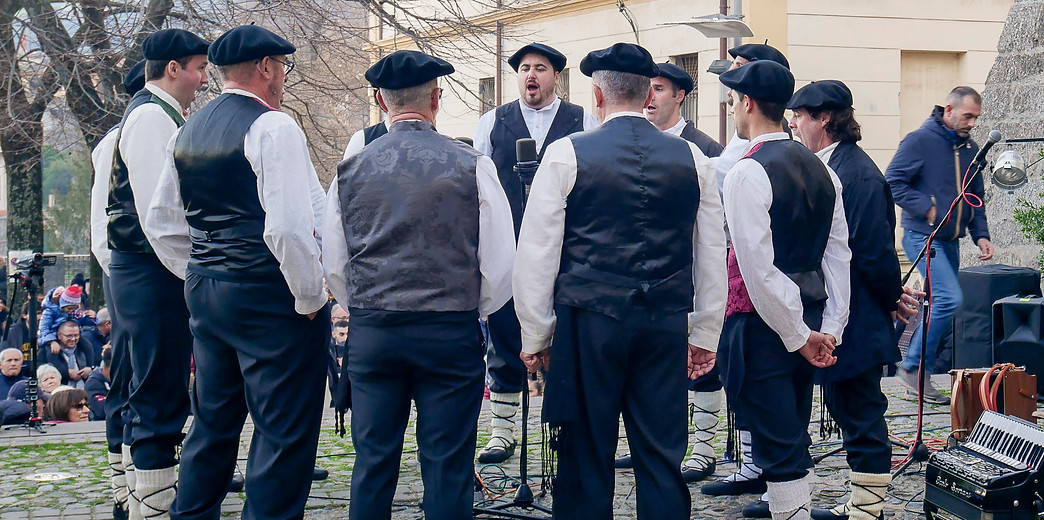
Cantigos in Carrela, a hymn to tradition
The second day had a completely different character, bringing together all the Sardinian music groups and ERAGIYOK. They all took part in an itinerant journey through the historic centre of the town, one of the best preserved medieval sites in Sardinia.
Starting from the Market Square, the organisers set up various stages where the choirs and the local dance group performed, while the locals and visitors joined in the spectacle by surrounding and interacting with the artists between performances. This went on until well into the night, in a show that sought to take music out of the enclosed spaces and reconnect with the popular tradition of singing in the street, and which ended in a festive atmosphere of fraternisation.
'Un barbiere di qualità'

2026 Season of the Luis Mariano Lyric Association - C. C. Amaia (Irun) - 9-10/05/2026, 19:00
Il barbiere di Siviglia (opera in due atti) - Music: Giachino Rossini - Libretto: Cesare Sterbini
Figaro: ANTONINO GIACOBBE // Rosina: FRANCESCA BRUNI // Almaviva: DINIS RODRIGUES // Bartol: ISIDRO ANAYA // Basilio: EMIL ABDOULLAIEV // Berta: IRENE BRANCHI // Fiorello: HODEI YÁÑEZ // Sergeant: DARÍO MAYA // ERAGIYOK abesbatza // Luis Mariano Chorus and Orchestra // Stage direction: Linda Rodrigues // Musical direction: Aldo Salvagno
After the performance given in November 2024 in the Kantua eta Elkartasuna cycle, ERAGIYOK took part in the same cycle again, closing the 2025 edition. On this occasion, the concert was held in the St. Ignatius of Loyola Church with a large audience that almost filled the temple.
For this performance in favour of the Zaporeak ERAGIYOK association, they had prepared a programme that combined sacred music, lyrical repertoire and Basque folklore. After an introspective start with Lomakin's magnificent Tebe poem followed by Guridi's Ave, Maria with the same character, the first of the most eagerly awaited moments came with Madina's well-known and spectacular Aita gurea. The emblematic work by the priest from Oñati allowed the choir to show its full range of sound, from the most delicate piano to the most sonorous forte.
Also noteworthy were the incursions into the lyrical section, including a fragment of the opera Macbeth, recently performed in Irun, and the premiere of one of the five works that the German composer Johannes Brahms wrote for bass voices ‘a cappella’, Geleit.

In Basque folklore, as well as old classics such as Boga, boga, Euskalerria and Nere etxea, there were several novelties. Thus, Txeru by Guridi and the satirical song Erriko festa by Zubizarreta could be heard for the first time in the voices of ERAGIYOK.
If throughout the concert the audience's response was favourable, their approval was heard even louder during the encores. The audience burst into applause with Nere maitiarentzat by Iparragirre and, especially, with the last premiere of the night, the joyful Pilota partida bat by Tomás Aragüés, in which five soloists from the choir could be heard perfectly supported by the whole ensemble.
After receiving souvenirs from the organisers and Zaporeak, there was still a chance to listen to one more song, a solemn Agur zaharra, which was the perfect ending to a concert that left a great taste in the mouth.
Rediscovering Valentin Larrea

Valentin Larrea 150th anniversary - Church of St. Vincent (Urrugne) - 22/05/2026, 19:00
WORKS FOR ORGAN: Preludio, Adagio y Fuga // Andante en Do Mayor // Elevación y plegaria // Andante religioso // WORKS FOR SOLO TENOR AND ORGAN: Motete al Santísimo // Panis Angelicus // Ave, Maria // Ikazkina mendian // WORKS FOR MALE CHOIR: Villancico al Niño Jesús // Eresiak // Euskal festak // Nere etorrera
Conductor of ERAGIYOK: Jon Larrauri Delika
Solo tenor: Aitor Garitano Agirreolea
Organ: Ignacio Arakistain Agirre
The church in Urrugne hosted the first of a series of concerts featuring organ, solo tenor and choir organised throughout 2026 to mark the 150th anniversary of the birth of Valentin Larrea.
Repertoire for organ and works for solo tenor and accompaniment
The concert began with organ music performed by Ignacio Arakistain, a great connoisseur of this part of the musician’s repertoire. Prelude, Adagio and Fugue featured a powerful opening, a softer middle section and a more contrapuntal and academic conclusion. This was followed by Andante in C major, originally composed for piano, in which Larrea employs a more cheerful tone. Elevación y Plegaria, a two-part piece with a religious air, offered the opportunity to discover a more intimate side of Larrea. To conclude this section, Andante religioso proved to be a work full of inspiration, in which lyrical sections are interspersed with more powerful ones.
In the section for solo tenor and accompaniment, four works were also selected, all performed by Aitor Garitano.
In Motete al Santísimo, Panis Angelicus and Ave Maria, Larrea gives prominence to the voice whilst demonstrating his ability to draw unique timbres from the accompanying instrument. The three are different, but in all three pieces we can discern echoes of the sources that inspired Larrea at that time: so-called musical nationalism, which involved the revival of folk melodies; the composition of lyrical works for organ; and the romantic extension of the voice. The work Ikazkina mendian, for its part, showcased the composer’s more operatic or dramatic side. With its text in Basque, traces of Italian-influenced operas can be glimpsed here.

His works for male choir
Since 2024, ERAGIYOK has been working to recover some of the composer’s choral works and has been premiering a number of them. Four of these works were performed at the concert.
With the singers positioned at the altar of the church, the choir began, accompanied by the organ, with Villancico al Niño Jesús, which tells the story of the shepherds who come to the birth of the Son of God and their encounter with the angelic choirs, in a traditional hymn from the Catholic liturgy.
This opening piece was followed by two a cappella works. The first of these, Eresiak, had been revived in April 2024 by ERAGIYOK in the musician’s hometown. The music set to Emeterio Arrese’s poem made an even greater impact, if that were possible, than in previous performances with the choir. A work demanding in terms of vocal range for the singers, and especially for the first tenors, the choir demonstrated that their prior rehearsals of the piece had led to a complete mastery of it, with its wide variety of tempos, contrasts and nuances.
A similar or even greater challenge came with the next work, Euskal festak, which was a genuine revival, as the date of its last performance was unknown, assuming it had been premiered previously. A rhapsody in three entirely distinct parts inspired by three texts found in 19th-century basque songbooks (Gaztetarzunac banarabila, Izar ederrac and Errucarriya), it is a piece that is harmonically easier for the general public to listen to, but whose performance again presents great difficulty due to its high register, the long solo passages and the constant interplay between the voices, featuring contrasts and passages sung with the mouth closed. The two soloists, a tenor and a baritone, performed their roles with aplomb and were rewarded with a standing ovation, as was the rest of the choir at the end of the work.
To conclude the choral section and, with it, the concert, the organ joined the choir once more in Nere etorrera, with lyrics by Iparraguirre but an original melody. The contrast employed by Larrea in his composition, where the melancholic air of the first part gives way to a vibrant zortziko, transported the audience in the most compelling way to the experience lived by Iparraguirre.
A triumphant finale that prompted a resounding ovation and a bow from all the stars of the evening. An unbeatable opportunity to rediscover Valentin Larrea.
ERAGIYOK wins in Kraków!

15th Internantional Choir Festival - Kraków (Poland)
Competition phase: male choirs - Mieczysław Karłowicz State Music School - 13/06/2026, 11:30
ERAGIYOK (Astigarraga, Basque Country) // Højby Drengekor (Nykøbing Sjælland, Denmark) // Bergen Mannskor (Bergen, Norway) // Chór Męski Pochodnia (Częstochowa, Poland)
Exhibition concert - Church of St Catherine - 13/06/2026, 19:00
Kärntner Singgemeinschaft in Wien (Hagenbrunn, Austria) // ERAGIYOK (Astigarraga, Basque Country) // Estonian Female Choir Vanaemad (Tallinn, Estonia) // Vox Carl Johan (Göteborg, Sweden) // Halo Choir (Taiwan)
Gala concert - Philharmonic Hall - 14/06/2026, 15:00
Ave, verum corpus (V. Goicoechea) // Kyrie (P. Janczak) // Aita gurea (F. Madina) // Kitolis (L. Aramburu) // Joan nintzen Ainoara (T. Aragüés Bayarte)
Conductor: Jon Larrauri Delika
“ERAGIYOK, Astigarraga, Basque Country!” was the announcement heard in the auditorium of the Philharmonic Hall during the closing gala and awards ceremony of the 15th Kraków International Choral Festival, in which ERAGIYOK took part over the weekend.
Competition on Saturday morning
It had all begun two days earlier. The 30 participants in the competition were divided into nine categories, and ERAGIYOK’s turn came on Saturday morning, at an unusual time of day when voices struggle to find their stride. With just 15 minutes to work with, the choir had to showcase the results of their work over the past few months whilst also trying to impress the jury with their performance.
The performance, comprising four works, brought together a variety of elements. Sacred music took centre stage in the first two pieces, both of which were very different from one another: Vicente Goicochea’s 'Ave, verum corpus' exudes elegance; on the other hand, Piotr Janczak’s 'Kyrie' is a work full of dynamic and tempo contrasts, fusing the tradition of religious music with trends in contemporary composition. In both performances, ERAGIYOK demonstrated great vocal technique alongside versatility.
This was followed by two classics from our folklore. The first, ‘Kitolis’, began with the choir singing with their mouths closed, giving way to the narration of the tragic story of the work’s namesake, told and sung with emotion by one of the soloists. Following this opening, the piece took a 180-degree turn with the liveliness of the zortziko and the ezpatadantza. The choir mastered these two quintessentially Basque rhythms to perfection, and the interplay and balance between the choir’s parts and those of a second soloist were excellent.
All that was needed to round off the performance was one more piece, which came in the form of ‘Joan nintzen Ainoara’. With the choir singing in six-part harmony, the ensemble displayed strength and vitality, as well as a beautiful interplay between the different voices, culminating in a ‘fortissimo’ that echoed throughout the main hall of the State School of Music where the competition was being held.

Showcase concert at St Catherine
Feeling that they had done a great job and looking forward to the final gala, the voices of ERAGIYOK could be heard in the church of Santa Catalina on Saturday afternoon.
Those present enjoyed the choir’s singing, and quite a few people approached the choristers afterwards to congratulate them and find out more about the pieces, particularly those performed in Basque.

Closing ceremony with the announcement of the winners
And so we came to the aforementioned event on Sunday, at which ERAGIYOK had the opportunity to perform ‘Kitolis’ once again, followed by the announcement of the winners, with this accolade marking yet another step forward in ERAGIYOK’s career.
Celebration of male choirs in AHOBER

3rd choral cycle of equal voices AHOBER - Erribera kulturgunea (Astigarraga) - 20/09/2025, 18:30
ERAGIYOK: Matsaren orpotik (J. Guridi) // FÜNF LIEDER: Geleit (J. Brahms) // Adios ene maitia (Aita Donostia) // Neskazarrak (P. Aldave) || FERRUM:
O Adonai (A. Pärt) // O magnum mysterium (M. Lauridsen) // Ol lux beata Trinitas (F. Mendelssohn-Bartholdy) // Lux Aurumque (E. Whitacre) // Virgen de la Barquera (J. Gavito) // Viento del mar (J. Domínguez) // Ferrum (J. Gavito) || FERRUM & ERAGIYOK: Nerea izango zen (J. Busto) // Boga, boga (J. Guridi) // Agur, jaunak (J. Olaizola)
Conductor of FERRUM: Marco Antonio García de Paz
Conductor of ERAGIYOK: Jon Larrauri Delika
ERAGIYOK and FERRUM joined forces in the second concert of the series organised by ERAGIYOK on an afternoon that brought together numerous music lovers at Erribera kulturgunea, attracted by the presence of the Asturian choir, recent winner of the Ejea de los Caballeros Choir Competition, one of the most prestigious competitions held in Spain.
Following the same format used on previous occasions, the host choir ERAGIYOK performed the first pieces of the concert, all of them new additions to their repertoire, including the lively Matsaren orpotik by Guridi and Neskazarrak by Aldave, and an intimate Adios ene maitia by Aita Donostia.
After this appetiser came the main event of the afternoon, the performance by the guest choir FERRUM. The Asturians, who began their journey in 2019 as part of the “El León de Oro” musical project, began their performance with the sacred work Adonai, with almost thirty singers surrounding the audience and conducted by their director Marco Antonio García de Paz from the upper rows of the auditorium. They continued with a sequence of sacred music, alternating classical works such as Mendelssohn's O lux beata Trinitas with contemporary works by musicians such as Lauridsen and Whitacre.

Moving on to secular music, the evocation of their seafaring origins in Luanco came in the form of Viento del mar and Virgen de la Barquera, a composition premiered at the Santa Vicente de la Barquera Seafaring Song Contest, where they won second prize, written by choir member and composer Jesús Gavito. Their final piece, named after the choir, Ferrum, was also impressive, alternating different rhythms accompanied by percussion and the sound of the horn, and offering a vibrant development and finale that sparked ovations and cries of “Bravo!” from the audience.
After an exchange of memories between the two conductors and with all the singers on stage, their voices joined together for the final part of the concert, in which Basque music once again took centre stage with the classic Boga, boga and the symbolic Nerea izango zen (Txoria txori) arranged by Javier Busto, which served to send a message reminding us of the terrible situation in Gaza.
There was still time to close the evening with a solemn Agur, jaunak, which the audience listened to standing up, putting the finishing touch to a great concert.
In favour of ATECE in Day of Acquired Brain Injury

Day of Acquired Brain Injury - Concert in favour of ATECE Gipuzkoa - Church of San Vicente (San Sebastián) - 25/10/2025, 18:00
Tebe poem (G. Lomakin) // Agur, Maria (P. Aldave) // Aita gurea (F. Madina) // Beati mortui (F. Mendelsshon-Bartholdy) // FÜNF LIEDER: 1. Ich schwing mein Horn ins Jammertal (J. Brahms) // FÜNF LIEDER: 3. Geleit (J. Brahms) // Izar ederra (F. Escudero) // Beti maite (R. Sarriegi) // Txeru (J. Guridi) // Maitia, nun zira? (J. Uruñuela) // Neskazarrak (P. Aldave) // Pilota partida bat (T. Aragüés Bernad)
Conductor: Jon Larrauri Delika
ERAGIYOK and FERRUM joined forces in the second concert of the series organised by ERAGIYOK on an afternoon that brought together numerous music lovers at Erribera kulturgunea, attracted by the presence of the Asturian choir, recent winner of the Ejea de los Caballeros Choir Competition, one of the most prestigious competitions held in Spain.
Following the same format used on previous occasions, the host choir ERAGIYOK performed the first pieces of the concert, all of them new additions to their repertoire, including the lively Matsaren orpotik by Guridi and Neskazarrak by Aldave, and an intimate Adios ene maitia by Aita Donostia.
After this appetiser came the main event of the afternoon, the performance by the guest choir FERRUM. The Asturians, who began their journey in 2019 as part of the “El León de Oro” musical project, began their performance with the sacred work Adonai, with almost thirty singers surrounding the audience and conducted by their director Marco Antonio García de Paz from the upper rows of the auditorium. They continued with a sequence of sacred music, alternating classical works such as Mendelssohn's O lux beata Trinitas with contemporary works by musicians such as Lauridsen and Whitacre.
Moving on to secular music, the evocation of their seafaring origins in Luanco came in the form of Viento del mar and Virgen de la Barquera, a composition premiered at the Santa Vicente de la Barquera Seafaring Song Contest, where they won second prize, written by choir member and composer Jesús Gavito. Their final piece, named after the choir, Ferrum, was also impressive, alternating different rhythms accompanied by percussion and the sound of the horn, and offering a vibrant development and finale that sparked ovations and cries of “Bravo!” from the audience.
After an exchange of memories between the two conductors and with all the singers on stage, their voices joined together for the final part of the concert, in which Basque music once again took centre stage with the classic Boga, boga and the symbolic Nerea izango zen (Txoria txori) arranged by Javier Busto, which served to send a message reminding us of the terrible situation in Gaza.
There was still time to close the evening with a solemn Agur, jaunak, which the audience listened to standing up, putting the finishing touch to a great concert.
Grand opening of the Castro Urdiales Musical Autumn Festival

39th Otoño Musical - Church of Santa María de la Asunción (Castro Urdiales) - 08/11/2025, 20:30
Tebe poem (G. Lomakin) // Agur, Maria (P. Aldave) // Aita gurea (F. Madina) // Beati mortui (F. Mendelsshon-Bartholdy) // FÜNF LIEDER: 1. Ich schwing mein Horn ins Jammertal (J. Brahms) // FÜNF LIEDER: 3. Geleit (J. Brahms) // Boga, boga (J. Guridi) // Izar ederra (F. Escudero) // Neskazarrak (P. Aldave) // Adios, ene maitia (Aita Donostia) // Matsaren orpotik (J. Guridi) // Kitolis (L. Aramburu) // MARINA: Coro de marineros (E. Arrieta) // Euskalerria (P. Sorozabal) // Maite (P. Sorozabal) // Pilota partida bat (T. Aragüés Bernad) // Agur, jaunak (J. Olaizola)
Conductor: Jon Larrauri Delika
Pianist: Miren Gabirondo Olazabal
ERAGIYOK starred in the opening concert of the 2025 edition of Otoño Musical. The festival, which takes place on weekends in November, is one of the most traditional choral events in Cantabria, having begun 40 years ago, and is organised by the Los Templarios choir and the local council.
The Church of Santa María de la Asunción, the most important Gothic temple in Cantabria and declared an individual asset within the Caminos de Santiago de Compostela, a UNESCO World Heritage Site, looked magnificent with the audience occupying almost all the seats.
Sacred music and German composers for the first part
For the concert, ERAGIYOK prepared a programme that combined some classics with works recently added to its repertoire. The performance began, as usual, with a section of sacred music. After a grandiose Aita gurea, this first section closed with one of the main works in the repertoire for deep voices a capella, Beati mortui by F. Mendelssohn-Bartholdy, which allowed the group to showcase the contrast between the choral passages and those of the solo quartet, featuring Mikel Zapiain (first tenor), Ander Sanz (second tenor), Iñaki Calleja (baritone) and Andoni Lardizabal (bass).
This last piece served as a pretext to link to another German composer, Johannes Brahms, and some of his works written for a cappella male choir and grouped together in Fünf lieder (Five Lieder).

Basque folklore and a spectacular finale
The second part of the concert was devoted to Basque folklore and a more lyrical repertoire. Along with two classic sea shanties, Boga, boga (which many in the audience hummed along to) and Kitolis, the lively Neskazarrak and Matsaren orpotik stood out for their liveliness and nuance. These were counterpointed by the melodious harmonies of Izar ederra and Adios ene maitia, where the choir showed off its maximum expressive capacity.
The official programme closed with three songs accompanied by piano, for which ERAGIYOK once again enlisted the help of Miren Gabirondo: the Sailors' Choir from the opera Marina, and the zortzikos Euskalerria and Maite (the latter in its original version) by Pablo Sorozabal. If the response was extraordinary throughout the reception of canta canto, this finale with a song so well known outside our borders brought the audience to its feet in a standing ovation for the choir.
At this point, there was an exchange of souvenirs, with ERAGIYOK receiving a beautiful print from the locals as a memento of the 50th anniversary of the host choir Los Templarios, as well as a representative figure of Castro Urdiales presented by the local mayor, Susana Herrán.
With success already assured, and true to tradition, the performance ended on a high note with Pilota partida bat and Agur, jaunak, which the audience listened to respectfully while standing, showing that our music and customs have taken root beyond our geographical and cultural boundaries. A brilliant end to a great concert.
The opera gala organised by ERAGIYOK crowds Erribera

3rd choral cycle of equal voices AHOBER - Erribera kulturgunea (Astigarraga) - 20/12/2025, 19:00
DIE ZAUBERFLÖTE: O Isis und Osiris (W. A. Mozart) // RIGOLETTO: Gualtier Maldé ... Caro nome (G. Verdi) // RIGOLETTO: Duca! Duca! ... Possente amor mi chiama (G. Verdi) // LA FILLE DU RÉGIMENT (G. Donizetti): Chacun le sait, chacun le dit // LA FILLE DU RÉGIMENT (G. Donizetti): Dès que l'appel sonne (G. Donizetti) // FIDELIO: Chor der Gefangenen - O welche lust! (L. v. Beethoven) // MARINA: Brindis (E. Arrieta) // LA TABERNERA DEL PUERTO: Eres blanca y hermosa ... En un país de fábula (P. Sorozabal) // LA TABERNERA DEL PUERTO: ¡No puede ser! (P. Sorozabal) // IL TROVATORE: Vedi! Le fosche notturne spoglie (G. Verdi) // The little drummer boy (K. Davis) // Noël popular vasco (Secundino Esnaola) // O Holy Night (A. Adam) // LA TRAVIATA: Brindisi (G. Verdi)
Conductor: Jon Larrauri Delika
Soprano: Ainhoa López de Munain // Tenor: Josu Cabrero // Pianist: Henar F. Clavel
The Astigarraga auditorium was decked out to enjoy the show offered by ERAGIYOK, accompanied for the occasion by soprano Ainhoa López de Munain, tenor Josu Cabrero and pianist Henar Fernández Clavel. For nearly an hour and a half, choirs and opera scenes alternated on stage, along with Christmas carols, and the choir and soloists were a resounding success in a festive and Christmassy closing to the AHOBER cycle.
Great scenes from opera and zarzuela
Although it was not a staged performance, the choir and soloists brought realism to their interpretation. ERAGIYOK tackled some of the most iconic scores from the operatic repertoire for bass voices, such as the chorus of priests from Mozart's The Magic Flute, Dès que l'appel sonne from La fille du régiment and the chorus of prisoners from Fidelio, performing admirably in all their solo pieces, and with particular brilliance in the latter passage.
There were some very memorable moments in the section where the choir sang alongside the soloists. For example, in the two scenes from Rigoletto: in the first, the Alava soprano Ainhoa López de Munain stepped into the shoes of Gilda, offering a very delicate Caro nome; similarly, Josu Cabrero and ERAGIYOK in the vibrant scene Duca! Duca! ... Possente amor, where the choir played the role of courtiers and the tenor from Biscay played the Duke of Mantua. Both numbers were met with loud applause from the audience.
Basque composers took centre stage with the famous toast A beber, a beber from Emilio Arrieta's opera Marina, in which the choir gave its all and featured stellar performances by Josu Cabrero in the role of Jorge and ERAGIYOK baritone Iñaki Calleja as Roque. No less applauded were Ainhoa López de Munain and Josu Cabrero in their respective songs from Pablo Sorozabal's La tabernera del puerto: En un país de fábula and No puede ser. The lyrical section ended with the famous gypsy chorus from the opera Il Trovatore.

Universal carols and a festive farewell
During the acknowledgements, the members of ERAGIYOK expressed their gratitude for the support provided by local institutions and companies, as well as by the Friends of ERAGIYOK, whose contributions help the choir throughout the year.
Once the soloists had received their respective mementos of their time at AHOBER, it was time for the carols, where all the participants had their moment to shine. ERAGIYOK performed The Little Drummer Boy in its original version; followed by Secundino Esnaola's Noël popular vasco (Basque popular Christmas carol), in which the verse sung by Josu Cabrero recalled the tradition of going from house to house congratulating people on the arrival and departure of the new year; the highlight came with the version of the universal O Holy Night written for soprano, choir and piano, which was one of the great triumphs of the evening.
After all the performers had taken their bows and the soloists had to come out twice to repeat their final curtain call, the grand finale in the form of an encore was thoroughly festive and came in the form of the famous Brindisi from La Traviata. In keeping with the libretto, champagne flowed and the audience gave another standing ovation to all the participants in the evening. It was a brilliant end to the year, on the eve of 2026, which will be full of challenges and projects for ERAGIYOK.
